Inside the Studio: What a Master Jewelry Artisan Understands That Most Buyers Never Consider
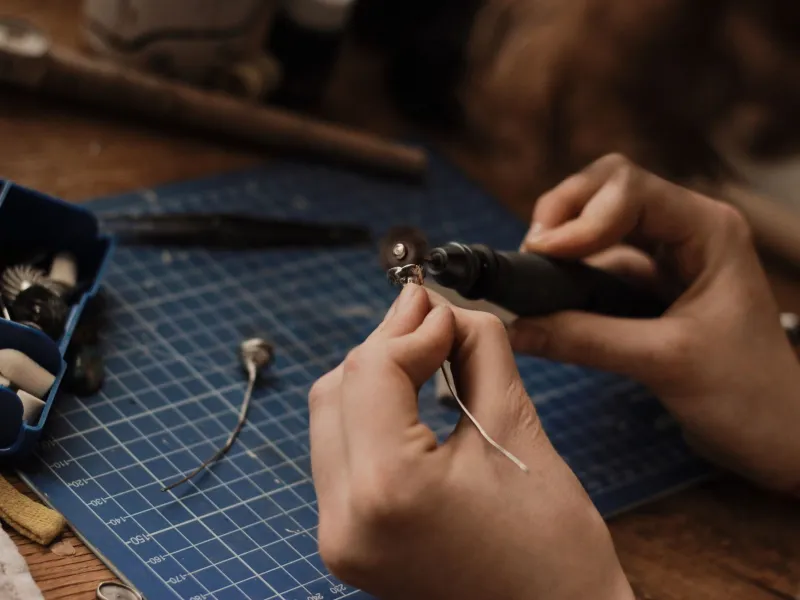
The workbench is not what most people imagine. There are no velvet trays or spotlit display cases. There are steel mandrels, drawplates worn smooth from years of use, small jars of flux and patina solutions, and the particular quality of light that a craftsperson arranges with the same deliberateness she applies to everything else. This is where exceptional jewelry is actually made — not in a showroom, not in a marketing meeting, but at a bench that has absorbed decades of work.
We recently had the privilege of spending an extended afternoon with a master jewelry artisan whose work has informed the Siviri design philosophy. What follows is a conversation about craft, material intelligence, and the kind of knowledge that takes years to acquire and cannot be replicated by machinery.
When you look at a piece of jewelry — one you didn't make — what do you see first?
The join. Always. I look at where things connect. Prongs to settings, bezels to shanks, links in a chain. That's where the honesty of a piece lives. Anyone can make something look beautiful in a photograph. What tells me whether a maker truly understands their materials is how they've handled the points of stress. A poorly executed solder joint will fail. It might take five years or it might take twenty, but it will fail. And when it does, the stone is at risk, the structure is compromised, and the piece is often beyond repair.
What do most buyers not think to ask about when commissioning a piece?
Gauge. Wall thickness. They'll ask about the stone — the color, the origin, the grade — and those are important questions. But the gauge of the metal determines the piece's wearability over time. I've seen beautiful rings with shanks so fine they deform within a year of daily wear. The customer loves the delicacy of it, and I understand the aesthetic appeal, but delicacy has to be engineered, not simply assumed. There's a version of every design that looks exactly as refined but is built to last a lifetime. That's the version worth commissioning.
The Intelligence of Material Choice
The conversation about metal is more nuanced than most buyers realize. Gold, for instance, is not a single material. Its behavior — its hardness, its color, its resistance to wear — changes meaningfully depending on its alloy composition. Yellow gold at 18 karats behaves differently from 14 karat yellow gold, and differently again from 18 karat rose gold, which contains copper and will develop a distinctive surface character over time.
How do you guide clients who come in with strong preferences about metal but limited technical knowledge?
I ask them about their life. Not their aesthetic preferences — their actual life. Do they work with their hands? Do they wear the piece every day or on occasion? Do they swim, garden, cook frequently? A platinum setting on a ring worn daily by someone who works in a kitchen or a workshop makes more sense than white gold, even though they look nearly identical to most eyes. Platinum is denser, more durable, and it develops a patina rather than losing metal over time. White gold, by contrast, requires replating to maintain its appearance. Neither is wrong. But one is right for that person.
This kind of conversation — about lifestyle, about habit, about the physical reality of how a piece will be worn — is what separates a commission from a transaction. It's also what makes the resulting piece genuinely personal rather than simply customized.
What the Eye Doesn't Catch
You mentioned stone placement earlier. What do most people not understand about how stones are set?
Tension. The relationship between a stone and its setting is a structural conversation. When I set a stone, I'm not simply securing it — I'm distributing force across its surface in a way that protects it from impact while allowing light to move through it as the designer intended. A bezel set too tightly can stress a softer stone and cause fracturing over years. A prong set too loosely creates micro-movement that eventually wears the prong away from the inside.
I also consider the stone's natural inclusions and fracture lines before I decide on placement and setting style. Two stones of identical grade can require very different approaches depending on where their internal characteristics are located. This is not something you can automate. It requires handling the stone, examining it under magnification, and making a judgment call that draws on years of experience.
What do you wish more clients understood before they came to you for a commission?
That the design conversation is only half the commission. The other half — the material conversation, the structural conversation — is equally important and often more consequential. A design can be adjusted. A structural decision made incorrectly at the beginning of a project is much harder to correct.
I also wish more clients understood that the questions they ask during the commission process make the piece better. When a client asks why I'm recommending a particular setting style or a specific alloy, that forces me to articulate decisions I might otherwise make intuitively. That articulation almost always leads to a refinement. The most successful commissions I've done have been collaborative in the deepest sense.
The Philosophy Behind the Bench
How do you think about the lifespan of a piece when you're making it?
I think in generations. Not in a romantic sense — in a practical one. I want the piece to be wearable and structurally sound fifty years from now. That means the joins need to be clean enough to rework if necessary. It means the stone setting needs to allow for re-tipping prongs without disturbing the stone. It means the finish needs to be one that ages gracefully rather than one that simply looks good when it leaves the bench.
There's a kind of arrogance in making something that's only meant to be beautiful today. The materials I work with — gold, platinum, precious stones — have been present on this earth for millions of years. They deserve more than a ten-year lifespan.
This is the knowledge that lives in a studio — in the hands, the eyes, and the considered judgment of someone who has spent a career in conversation with metal and stone. It cannot be acquired quickly, and it cannot be replicated by any process that removes the human from the work. For those who commission or collect handcrafted jewelry, understanding even a fraction of this technical depth transforms the experience from acquisition to genuine appreciation.
At Siviri, every piece begins with exactly this kind of conversation — one that treats craft not as a romantic notion, but as a discipline worthy of the deepest respect.