What Your Hands Already Know: The Sensory Signatures of Truly Handcrafted Jewelry
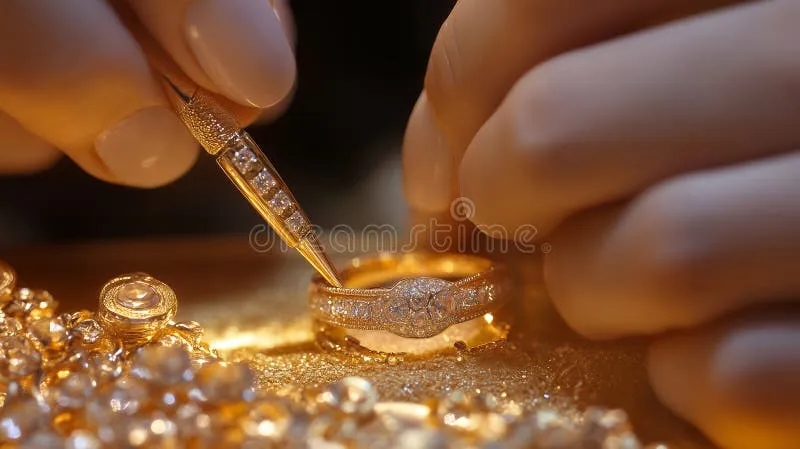
Photo: artisan jeweler crafting gold ring close up hands workshop luxury, via thumbs.dreamstime.com
Before the eye registers the quality of a handcrafted jewel, the hand already knows it. The particular weight of forged metal, the subtle resonance of a clasp closing with precision, the warmth a well-finished surface holds against the skin — these are not incidental details. They are the vocabulary of genuine craftsmanship, and they speak in a language that no mass production line has yet learned to replicate.
We tend to evaluate jewelry visually first. Photographs, display cases, and digital storefronts have trained us to lead with sight. But experienced collectors and artisans alike will tell you that the truest measure of a piece's quality is revealed only through touch, wear, and the quiet sounds a well-made jewel makes as it moves through the world.
The Weight That Tells the Truth
Pick up two rings of ostensibly similar design — one handcrafted from solid, hand-forged metal, the other produced through high-volume casting or hollow construction — and the difference communicates itself instantly, before a single visual inspection is complete. Weight is among the most honest indicators of material integrity in fine jewelry.
Handcrafted pieces are typically worked from solid stock. The metal is manipulated directly: hammered, shaped, annealed, and refined through a process that preserves its density. The result is a piece with a satisfying heft — not heaviness for its own sake, but the honest mass of a material present in full. That weight settles on the wrist or finger with a kind of authority. It does not shift or spin unless invited to.
Mass-produced jewelry, by contrast, is frequently cast in ways that introduce air or thinning into the structure, reducing material costs and weight simultaneously. The piece may appear identical at a glance. But lift it, and the absence speaks clearly.
Sound as a Quality Indicator
This is the detail that surprises people most when they first encounter it: handcrafted jewelry sounds different.
A clasp on a finely made bracelet or necklace closes with a particular resonance — a clean, definitive sound that signals precision-fit components and solid construction. There is no rattle, no hollow click, no looseness in the mechanism. The sound is brief and complete, like a well-engineered door settling into its frame.
By comparison, clasps on mass-produced pieces often produce a thinner, higher sound — the acoustic signature of lighter-gauge metal and components manufactured to tolerances that prioritize speed over fit. Over time, these sounds tend to worsen as the mechanisms wear unevenly.
Charms and pendants tell a similar story. A handcrafted pendant swinging against a solid chain produces a tone with depth. The same motion on a hollow or plated piece yields something thinner, almost papery. These distinctions are not imagined. They are the physics of material density expressing itself in the only language available to it.
Artisans who work in metal develop a trained ear for these sounds during the making process itself. The ring of a hammer on well-annealed gold, the particular tone of a bezel being set correctly — sound is feedback in the workshop, a running commentary on quality that experienced makers listen to throughout their work.
Surface, Finish, and the Sense of Touch
Run a fingertip across a well-finished handcrafted surface and the sensation is remarkably consistent: smooth without being slippery, with a warmth that synthetic or heavily plated surfaces rarely achieve. This is partly a function of the finishing process — hand-polishing, by its nature, produces a surface with subtle variation that catches and holds warmth differently than a mechanically buffed finish.
Edges are another revealing point of contact. Handcrafted jewelry is refined at every transition: where a prong meets a band, where a link connects to its neighbor, where a bezel edge meets the stone. These junctions are smoothed and considered individually. The result is a piece that moves against the skin without catching, without the micro-abrasions that poorly finished edges produce over time.
In mass production, finishing is a throughput consideration. Pieces move through tumbling or machine-polishing processes in batches. The results are adequate but uniform in a way that reveals their origin — every edge treated identically, every surface finished to the same standard regardless of its position or prominence on the piece.
Warmth, Conductivity, and the Living Quality of Metal
There is a quality that longtime wearers of fine handcrafted jewelry often describe but struggle to articulate precisely: the sense that the piece becomes part of you quickly. It warms to body temperature with a responsiveness that feels personal.
This is not entirely poetic. Solid, high-karat metals — particularly gold — conduct and retain heat with a responsiveness that lower-karat alloys and plated metals do not replicate to the same degree. A handcrafted piece in solid 18-karat gold will reach your skin temperature within moments of being worn and hold it in a way that feels, for lack of a more technical word, alive.
This warmth is part of why fine jewelry feels different to wear, even when it looks similar to less precious alternatives. The metal is in genuine conversation with the body.
Why These Details Are Worth Knowing
Understanding the sensory language of handcrafted jewelry changes the way you shop, the way you wear, and ultimately the way you value what you own. It shifts the evaluation from the purely visual — susceptible to clever photography and surface-level finishing — to the embodied: the weight in your palm, the sound of a clasp, the feel of a polished edge against your finger.
These are details that cannot be faked at scale. They require time, skill, and the deliberate attention of a maker who cares about every dimension of the object they are creating — not just how it will look in a photograph, but how it will feel in twenty years of daily wear.
At Siviri, every piece is made with the understanding that luxury is a multisensory experience. The visual is only the beginning. What endures is everything your hands already know the moment you pick it up.