Crafting for Centuries: How to Know When a Custom Commission Is Worth the Investment
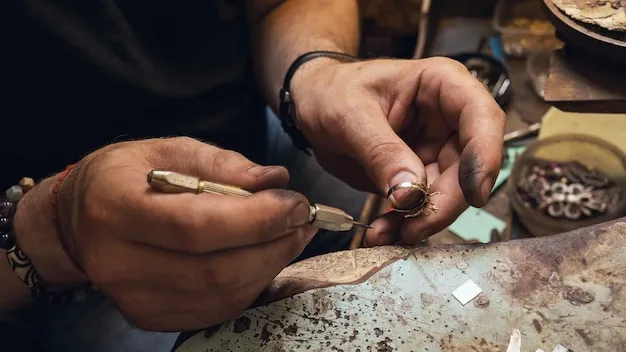
Photo: artisan jeweler handcrafting gold ring in workshop close up, via img.freepik.com
There is a particular kind of jewelry that does not merely adorn — it endures. It moves through time in a way that mass-produced accessories never can, accumulating significance with each passing generation. A grandmother's ring worn at a granddaughter's wedding. A pendant that carries the weight of a family's history without a single word of explanation. These are not accidents of sentiment. They are the result of a deliberate decision, made at a specific moment, to invest in something that transcends the wearer's own lifetime.
The question, then, is not whether such a piece is worth creating. It almost always is. The real question is: when is the right moment to commission one?
Recognizing the Moment That Calls for Something Permanent
Not every milestone warrants a custom commission. Birthdays, anniversaries, and personal achievements are all meaningful occasions — but the decision to commission a generational piece typically arises from something deeper than a date on the calendar. It emerges from a felt sense that a chapter is closing, or opening, in a way that deserves to be marked permanently.
The birth of a first child. A hard-won professional achievement after years of sacrifice. The passing of a beloved family member whose memory you wish to carry forward in a tangible form. These are the moments that tend to call for something beyond the ready-made. They carry an emotional gravity that, when translated into a handcrafted object, creates a lasting correspondence between feeling and form.
If you find yourself thinking not only about how a piece will look on you, but about how it might look on someone you haven't yet met — a child, a niece, a grandchild — that instinct is worth trusting. It is the first signal that you are thinking like a custodian rather than simply a consumer.
The Test of Timelessness
Trend-driven design has its place. A statement piece that captures the spirit of a particular era can be deeply satisfying to wear. But heirlooms demand a different standard: they must be as compelling fifty years from now as they are today.
This does not mean designing something cold or impersonal in the name of neutrality. It means choosing design elements with a long arc of resonance — forms drawn from nature, geometry, or classical tradition that have demonstrated staying power across decades and cultures. Think of the enduring appeal of a solitaire setting, the quiet authority of a well-proportioned bangle, or the way a finely engraved detail rewards closer inspection regardless of what decade you encounter it.
When consulting with a jeweler about a commission, it is worth asking directly: Will this design feel dated in twenty years? A skilled artisan will be candid about the difference between what is currently fashionable and what is architecturally sound over time. At Siviri, this conversation is central to every custom engagement — because a piece meant to be passed down must first be built to earn that passage.
Material Longevity Is Not an Afterthought
The emotional resonance of an heirloom is only as durable as the materials that carry it. This is where the practical considerations of commissioning intersect with the sentimental ones — and where many first-time commissioners are surprised by the depth of choice available to them.
Platinum, for instance, is frequently favored for heirloom-quality settings not merely for its prestige, but for its structural integrity. Unlike gold alloys that can thin and wear over decades of daily use, platinum develops a patina that many collectors find more appealing with age, and it holds stones with exceptional security. For those who prefer gold, 18-karat formulations offer a meaningful balance between purity and durability — a distinction worth discussing with your jeweler rather than leaving to assumption.
Gemstone selection carries equal weight. Diamonds remain the conventional choice for longevity, given their hardness, but sapphires, rubies, and certain varieties of emerald have long histories as heirloom stones precisely because of their durability and the depth of color that does not fade. Understanding the specific properties of a stone before it is set — its hardness on the Mohs scale, its susceptibility to light or chemicals, its structural integrity — is part of commissioning responsibly for the long term.
Encoding Personal Significance Without Limiting Future Meaning
One of the more nuanced challenges of heirloom design is the balance between personal specificity and universal resonance. A piece that is deeply personal to you may feel alienating or burdensome to the person who inherits it — particularly if its symbolism is too literal or too tied to your own story.
The most enduring heirloom pieces tend to carry meaning that can be reinterpreted across generations rather than locked into a single narrative. A motif drawn from your family's cultural heritage. A stone chosen for its connection to a place rather than a specific event. An engraving that speaks to a value — fidelity, courage, grace — rather than a date. These elements invite the next wearer to find their own relationship with the piece rather than simply inheriting yours.
This is not to suggest that personal details have no place. A discreet inscription on the interior of a band, a birthstone set alongside a more universal design element, a hallmark that references a family name — these touches add intimacy without overwhelming. The art is in the calibration.
When to Begin the Conversation
The practical timeline for a custom commission is longer than many clients anticipate. A piece designed and executed with the care that heirloom quality demands typically requires several months from initial consultation to delivery — sometimes considerably more, depending on the complexity of the design and the sourcing of materials.
This means that the right time to begin the conversation is almost always earlier than it feels necessary. If you are hoping to present a commissioned piece at a specific occasion, working backward from that date with a generous margin is essential. More importantly, the design process itself — the sketches, the revisions, the selection of stones — benefits from time and reflection. Decisions made in haste rarely produce pieces meant to last centuries.
At Siviri, we encourage clients to approach the commission process as a collaboration rather than a transaction. The questions you bring to the table — about your family's history, your aesthetic sensibilities, the person you hope will one day wear this piece — are not peripheral to the work. They are the work.
The Quiet Gravity of the Right Decision
Commissioning an heirloom is, at its core, an act of optimism. It presupposes that the future is worth investing in — that the relationships you value today will carry forward, that the story you are part of is worth preserving in a form that can be held in the hand.
That kind of conviction deserves to be matched with an equal seriousness of craft. When the moment arrives — and for many people, it arrives more than once in a lifetime — the decision to commission something truly lasting is one of the most meaningful investments a person can make. Not in jewelry, precisely, but in the idea that some things are worth building to endure.