Stone by Stone: Understanding Where Your Jewelry Comes From — and Why It Matters
Every gemstone carries two histories. The first is geological — millions of years of heat, pressure, and mineral convergence that produce something the human eye finds irresistible. The second is human — the hands that extracted it, the traders who transported it, the artisans who shaped and set it. Most jewelry lovers are well acquainted with the first history. The second, however, is where meaning deepens considerably.
For the intentional wearer, provenance is not a technical footnote. It is part of the piece itself.
The Geography of Gemstones
Precious stones are not distributed evenly across the earth's surface. They emerge from specific geological conditions that tend to concentrate in particular regions — and those regions leave their mark on the character of the stones they produce.
Cashmiri sapphires, mined from a remote Himalayan valley at elevations above 14,000 feet, are renowned for a velvety, cornflower blue that gemologists describe as having an almost internal luminosity. Their scarcity — the original deposits were largely exhausted by the early twentieth century — makes them among the most valuable colored stones in the world. A Kashmiri sapphire is not simply a blue stone; it is a geological event from a specific, almost inaccessible place.
Burmese rubies from the Mogok Valley in Myanmar carry a similarly storied reputation. The region's unique mineral composition produces a chromium-rich red that has been prized for centuries — a color so distinctive that the trade term "pigeon's blood" was coined specifically to describe it. Colombian emeralds, meanwhile, are distinguished by their warm, slightly yellowish green, a quality attributed to the particular hydrothermal fluids present in the Andes. Compare them to Zambian emeralds, which tend toward a cooler, more bluish tone, and the regional difference becomes immediately apparent.
These distinctions are not merely academic. When you understand that the stone on your finger emerged from a specific valley, a particular mountain range, a defined geological moment in the earth's history, the piece you are wearing becomes a kind of artifact — not just of craft, but of place.
Ethical Sourcing: What It Means and Why It Has Changed the Industry
The conversation around ethical sourcing in the jewelry industry has evolved significantly over the past two decades, driven in part by consumer awareness and in part by the industry's own recognition that provenance accountability is inseparable from quality assurance.
The Kimberley Process, established in 2003, was an early framework designed to prevent conflict diamonds — stones whose sale financed armed conflict — from entering the legitimate market. It represented a meaningful first step, though many in the industry have since acknowledged that its scope is limited and that more comprehensive standards are necessary to address labor conditions, environmental impact, and community benefit.
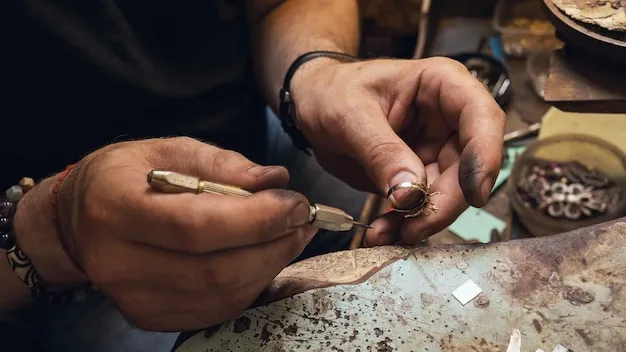
Today, a growing number of responsible jewelers work with suppliers who can provide chain-of-custody documentation — tracing a stone from the mine to the cutting house to the setting bench. Fairmined and Fairtrade certifications for gold provide a parallel framework for precious metals, ensuring that small-scale miners receive fair compensation and operate under safe conditions. For consumers who care about the full story of their jewelry, these certifications are meaningful signals worth asking about.
At Siviri, the sourcing conversation begins before a single design is drawn. The materials that go into a handcrafted piece are chosen not only for their visual and structural qualities, but for the integrity of their journey.
Metals Have Histories, Too
The focus on gemstone provenance sometimes overshadows an equally important conversation about precious metals — and gold in particular. Gold mining is among the most environmentally intensive extractive industries on earth, and the conditions under which it is mined vary dramatically depending on the source.
Recycled gold — recovered and refined from existing jewelry, electronics, and industrial materials — has emerged as a compelling alternative that reduces the demand for newly mined material without sacrificing quality. Many high-end jewelers now offer pieces made entirely from recycled metals, a choice that carries its own kind of intentionality: the gold in your bracelet may have once been a circuit board, a coin, or someone else's ring, its history layered and invisible but present nonetheless.
For those who prefer newly mined gold, Fairmined-certified sources provide assurance that the communities involved in extraction are treated equitably and that environmental protocols are followed. The premium associated with responsible sourcing is real, but for many clients, it is a cost that aligns comfortably with a broader philosophy of wearing with intention.
How Provenance Transforms the Experience of Wearing
There is a practical dimension to understanding where your jewelry's materials come from, and then there is the dimension that is harder to quantify but perhaps more significant: the way that knowledge changes the experience of wearing the piece.
A ring set with a Montana sapphire — one of the few precious gemstones mined domestically in the United States, from the Yogo Gulch deposit in the state's central plains — carries a specificity that a stone of unknown origin simply cannot. You know something about it. You can picture a landscape. You can trace a line from that landscape to your hand. That line is not decorative. It is a form of connection.
This is the philosophy that animates what we at Siviri call wearing with intention. A piece chosen with full awareness of its origins — the geological conditions that formed the stone, the human labor that extracted and shaped it, the artisanal hands that transformed it into something wearable — is a piece you engage with differently. It is not simply something you put on in the morning. It is something you carry.
Questions Worth Asking Before You Buy
For consumers who wish to approach their next jewelry purchase with greater provenance awareness, a handful of direct questions can open a productive conversation with any reputable jeweler.
Ask where the primary stones were mined and whether the supplier can provide country-of-origin documentation. Ask whether the metals used are recycled, Fairmined-certified, or sourced through other verified responsible channels. Ask whether the cutting and polishing of the stones was done under fair labor conditions — an often-overlooked step in the supply chain that can occur in regions with limited labor protections.
A jeweler who cannot or will not answer these questions is not necessarily operating unethically, but the inability to answer them does suggest a supply chain that has not been examined with care. For a purchase meant to be worn with intention, that examination matters.
The Full Story, Worn on Your Wrist
Luxury jewelry has always been about more than aesthetics. It has been about significance — the weight of something rare, the craft of something made by hand, the meaning of something chosen deliberately. Understanding the provenance of your jewelry's materials adds a dimension to that significance that no amount of visual beauty alone can provide.
The stone you wear began its life in the earth. It passed through hands you will never meet, traveled distances you may never travel, and arrived at a jeweler's bench where it was set into something intended for you. That is a remarkable journey. Knowing it — even in broad outline — is part of what it means to wear jewelry with the kind of awareness that transforms an accessory into something genuinely personal.