Built to Be Passed Down: The Case for Commissioning Jewelry That Outlives Trends
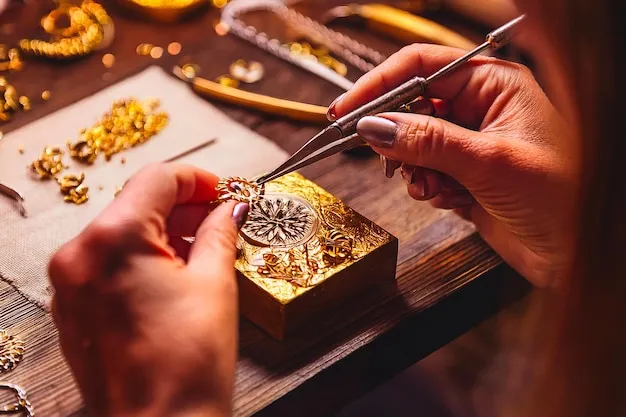
Photo: artisan goldsmith handcrafting fine jewelry in workshop close up, via img.freepik.com
There is a particular kind of courage required to invest in something that is not of the moment. In a culture that rewards the new — that celebrates the seasonal refresh, the limited-edition drop, the trend cycle turning once more — choosing to commission a piece of jewelry with the next generation in mind feels almost countercultural. And yet, for those who have worn a grandmother's ring or clasped a parent's bracelet around their wrist, the logic is undeniable: the most meaningful jewelry was never designed for a single season.
This is the central tension at the heart of what we might call the heirloom paradox. Contemporary luxury consumers are, rightly, drawn to pieces that feel current, that speak to who they are today. But the very nature of a handcrafted jewel — its weight, its permanence, its intimacy with the body — invites a longer conversation. How do you honor your present self while designing for a future you cannot fully imagine?
The Illusion of the Timeless Piece
The jewelry industry has long deployed the language of timelessness as a marketing shorthand, but the concept deserves more careful examination. True longevity in design is not achieved by stripping a piece of all personality in favor of generic classicism. A plain gold band is not timeless because it lacks character — it endures because its proportions, its material integrity, and its restraint allow it to absorb meaning over decades without competing with it.
The most enduring pieces in private collections and family histories share a set of quietly radical qualities: they were made with intention, constructed from materials chosen for durability rather than economy, and designed with a visual clarity that does not depend on a particular cultural moment to be understood. These are not accidents of taste. They are the result of deliberate craft decisions made at the point of creation.
At Siviri, this philosophy underpins every commission. The conversation between client and artisan begins not with "what is fashionable" but with "what is true" — to the wearer's aesthetic, to the integrity of the materials, and to the long arc of a life being lived.
Materials That Earn Their Place
The foundation of any heirloom-quality piece is the material from which it is made. Precious metals and ethically sourced gemstones are not merely beautiful — they are structurally suited to the demands of time in ways that plated alloys and synthetic substitutes simply are not.
Gold, particularly in its 18-karat and 22-karat forms, resists tarnish and structural fatigue across decades of wear. Platinum, denser and more resistant to scratching than white gold, is favored by artisans for settings that must protect stones across generations. The choice of metal is not merely aesthetic; it is a statement about the intended lifespan of the object.
Gemstone selection carries equal weight. Diamonds, sapphires, rubies, and emeralds — the traditional precious stones — earn their status not only through rarity but through hardness. A well-set sapphire will survive the rigors of daily wear and the inevitable jostles of a long life in a way that softer stones cannot guarantee. Understanding the Mohs hardness scale is not pedantry; it is the practical vocabulary of longevity.
Beyond raw material quality, the construction technique matters enormously. Handcrafted settings, formed and finished by a skilled artisan rather than cast en masse, allow for the kind of precision in prong placement and bezel depth that keeps stones secure across years of wear. Machine-produced pieces, however elegant in appearance, cannot replicate the attentiveness of a human hand calibrating tension by feel.
Designing for a Life You Cannot Predict
One of the most instructive exercises a prospective commissioner can undertake is to consider the jewelry that has already traveled across generations within their own family or circle. What made those pieces survive — not merely physically, but emotionally? Almost universally, the answer involves a combination of strong silhouette, material integrity, and a design that communicates something essential about the person who first wore it without requiring that context to be appreciated.
This suggests a practical principle: when commissioning a piece intended to become an heirloom, prioritize form over finish. Surface treatments — high polish, matte texture, oxidization — can be refreshed by a skilled jeweler. The underlying form, the proportions of a setting, the gauge of a band, the logic of a clasp mechanism — these are far more difficult to alter and far more consequential to longevity.
It also argues for restraint in the deployment of highly specific cultural references. A piece that speaks to a particular decade's aesthetic vocabulary may feel thrillingly current today and bewilderingly dated in thirty years. The most durable designs tend to be those rooted in enduring geometric principles, natural forms, or deeply personal symbolism that carries meaning independent of trend.
The Commission as Conversation
Perhaps the most underappreciated dimension of commissioning an heirloom-quality piece is the documentation that should accompany it. A handcrafted jewel is not merely an object; it is a record of a moment, a relationship, and a set of values. The story of its creation — the materials sourced, the design iterations considered, the artisan who shaped it — is as much a part of its legacy as the piece itself.
At Siviri, clients who commission custom work receive detailed records of their piece's provenance: the origin of the stones, the alloy composition of the metal, the care protocols suited to its specific construction. This documentation is not administrative formality. It is the beginning of a narrative that the piece will carry forward into the lives of whoever wears it next.
The heirloom paradox, then, resolves itself not in the choice between the contemporary and the enduring, but in the recognition that they are not opposites. A piece designed with genuine intentionality — with honest materials, skilled hands, and a design logic rooted in something deeper than seasonal appeal — can be entirely of its moment and entirely beyond it at the same time. That is not a paradox at all. That is the definition of luxury, properly understood.