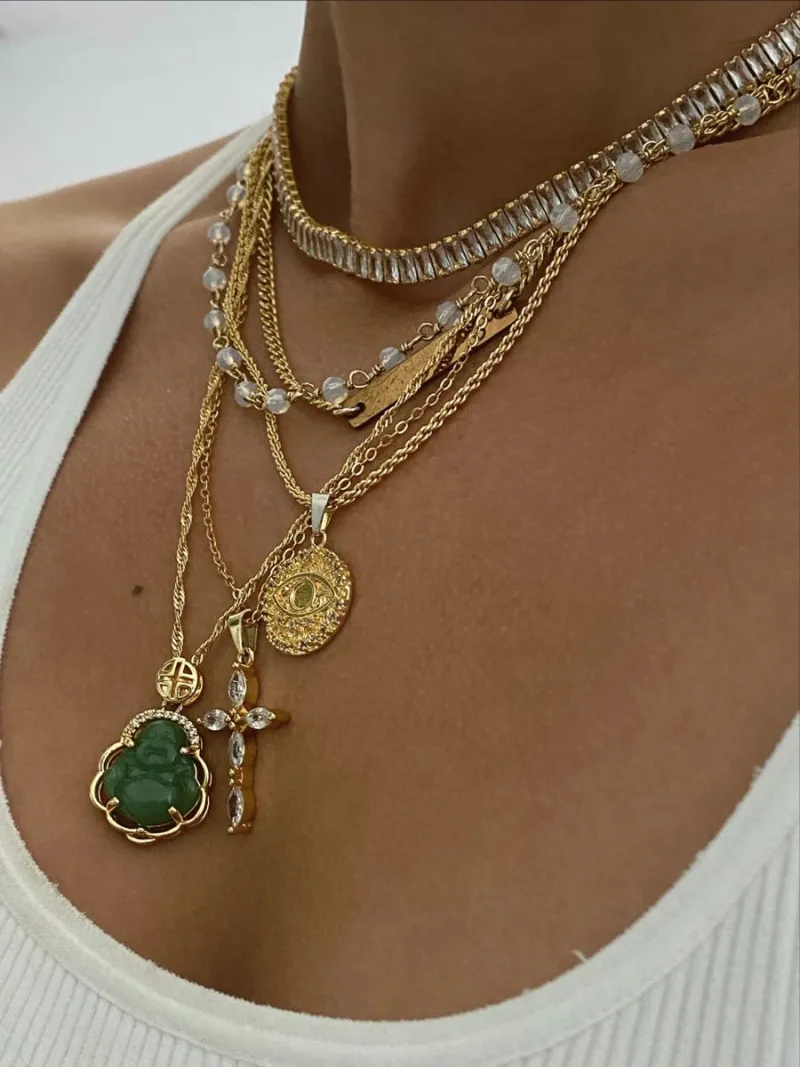
The Considered Collection: How to Build a Jewelry Wardrobe That Grows With You
There is a meaningful difference between owning a great deal of jewelry and owning a great collection. The former is a matter of accumulation; the latter is an act of curation. It requires the same qualities that distinguish any serious collector — patience, discernment, a willingness to pass over the merely beautiful in pursuit of the genuinely right — applied to a category that is uniquely personal because it is worn on the body, close to the self.
For the luxury jewelry enthusiast building a collection with intention, the guiding question is rarely "Do I love this?" That threshold, while necessary, is insufficient. The more useful question is: "Where does this live within the larger story I am telling through the pieces I choose to wear?"
This is the collector's lens — and it transforms the act of acquiring jewelry from a series of isolated decisions into a coherent, ongoing creative practice.
Begin with a Design Vocabulary
Every strong collection has a visual language — a set of recurring elements that create cohesion across pieces acquired over years or even decades. For some collectors, that language is architectural: clean lines, geometric forms, a preference for settings that foreground structure over ornament. For others, it is organic and textural: hammered metals, irregular stones, surfaces that suggest the natural world. Still others build around a tonal palette — a commitment to warm yellow gold and cognac-toned stones, or to the cooler register of white gold and icy diamonds.
Identifying your design vocabulary early is one of the most useful things you can do as a collector. It does not limit your choices — it clarifies them. When you encounter a piece that falls outside your established language, you are forced to ask whether it represents a genuine evolution of your aesthetic or simply a momentary attraction. That question alone has saved countless collectors from purchases they would later regret.
At Siviri, we often work with clients at precisely this stage — helping them articulate preferences they have felt instinctively but never named. The conversation is illuminating for both parties, and the pieces that emerge from it tend to be the ones clients wear most consistently and most meaningfully.
Think in Chapters, Not Moments
A jewelry collection that truly reflects its owner is organized around chapters of life, not individual occasions. This distinction matters because it shifts the frame from event-based purchasing — buying a piece for a specific dress, a specific trip, a specific season — to identity-based purchasing, in which each acquisition reflects something true about who you are at a particular point in your evolution.
Consider the difference between a necklace bought to complement an outfit worn to a single gala and a necklace commissioned to mark the year you launched your own company. Both pieces may be equally beautiful. Only one will still feel meaningful a decade from now, when the gala is forgotten but the courage it took to build something from nothing remains vivid.
When you approach each acquisition as a chapter marker — a piece that belongs to a specific phase of your life and carries its particular character — your collection becomes autobiographical in the best sense. It can be read, by you and by those who know you well, as a record of who you have been and what you have valued.
Establishing a Metals Strategy
One of the most practical decisions a serious collector makes is whether to commit to a primary metal or to work intentionally across multiple metals. Both approaches are valid; what matters is that the choice is made deliberately rather than by default.
Collectors who work within a single metal family — say, 18-karat yellow gold — benefit from an immediate visual coherence that makes stacking and layering effortless. Every new piece enters into an existing conversation, and the collection as a whole presents a unified aesthetic even when individual pieces span very different design eras.
Collectors who work across metals have more expressive range but face a greater curatorial challenge: ensuring that pieces in different metals can coexist gracefully. The most successful multi-metal collections tend to establish a dominant metal that appears in the majority of pieces, with secondary metals introduced sparingly and purposefully — perhaps reserved for pieces that mark a distinct life chapter or represent a deliberate aesthetic departure.
Whatever your approach, revisiting your metals strategy periodically is worthwhile. As your collection grows, you may find that certain pieces feel isolated — beautiful in themselves but disconnected from the larger whole. That is useful information, and it may guide your next acquisition toward something that bridges rather than diverges.
The Art of the Anchor Piece
Every significant collection has anchor pieces — works of such quality, character, and personal resonance that they serve as the collection's foundation. These are not necessarily the most expensive pieces you own, though they may be. They are the pieces around which everything else is oriented: the ring you almost never remove, the necklace that feels like a second self, the earrings that appear in photographs spanning twenty years.
Identifying your anchor pieces — or, if you are early in your collecting journey, aspiring toward them — gives your collection a gravitational center. New acquisitions can be evaluated in relation to these anchors: Do they complement or compete? Do they extend the aesthetic conversation or introduce a discordant note?
At Siviri, we believe that the finest handcrafted pieces are inherently suited to anchor roles. Their quality of execution, their depth of intention, and the uniqueness that comes from being made by hand rather than manufactured at scale give them a presence that mass-produced pieces rarely achieve, regardless of price point.
Curating Over Time: Editing Is Part of the Practice
A collection is not only built through acquisition — it is shaped through editing. The willingness to retire pieces that no longer reflect who you are is as important as the discernment that guides new purchases. This does not require selling or discarding; pieces can be held in trust for family members, repurposed through commission work, or simply set aside with gratitude for the chapter they represented.
Editing your collection periodically — perhaps annually, perhaps at significant life transitions — keeps it honest. It ensures that what you wear on your body continues to reflect the person you are becoming, rather than the person you were when you made an earlier, less considered choice.
The collector's lens, ultimately, is a lens turned inward as much as outward. It asks not only "What is beautiful?" but "What is true — about my aesthetic, my values, and the particular life I am living?" A collection built on those questions does not merely grow. It deepens. And that depth, worn close to the self day after day, is one of the quiet luxuries that no trend can manufacture.